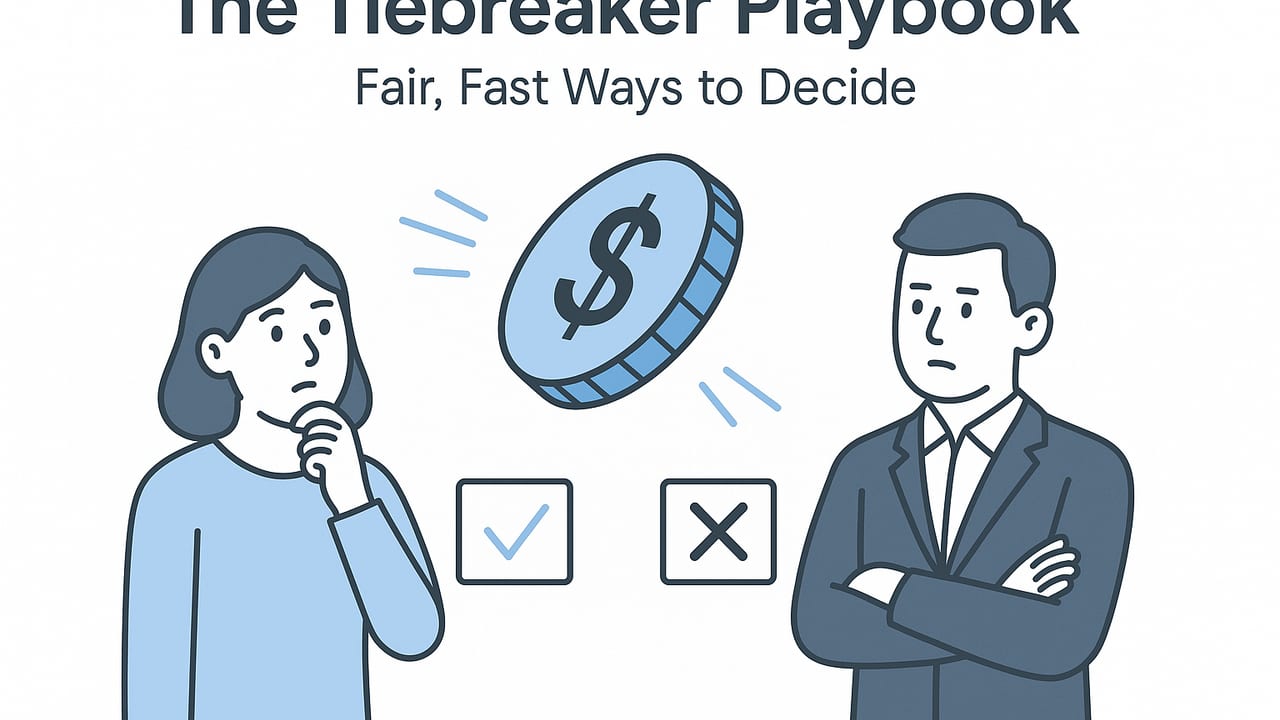
A tiebreaker is your shortcut out of a stalemate—whether you’re choosing dinner, selecting a team captain, or settling who gets the last slice of cake. The best tiebreakers are fair, fast, and agreed upon in advance. This guide explains simple, proven ways to pick a winner (or make a choice) without arguments, plus tips to keep every decision transparent and low-drama.
Rule #1 of any tiebreaker: Agree on the rules before you randomize.
What Makes a Good Tiebreaker?
Not all tiebreakers fit every situation. Use these principles to pick the right method:
- Fairness: Everyone has an equal chance, and the rules don’t favor anyone.
- Clarity: Simple steps, no confusion. Everyone understands how the winner is chosen.
- Speed: Quick to run, especially for everyday choices.
- Fit for stakes: The higher the stakes, the more transparent and repeatable the method should be.
- Repeatable: If you did it again, you’d get the same process (even if the outcome differs).
- Accessible: Works with what you have on hand—phone, coin, cards, paper, or even the clock.
- Low-drama: People accept the result without regret or re-arguing.
Quick Tiebreakers You Can Use Anywhere
1) Coin Flip (or Any 50/50 Alternative)
Best for: Two options, two people. Call it in the air, show result, done. If you don’t have a coin, assign “top” or “bottom” of a nearby object, or use a phone-based coin.
Tip: The person who calls the flip shouldn’t flip the coin. That small separation builds trust.
2) Spin the Wheel
Best for: Three or more choices. Create slices for each option and spin. Good when you want a little fanfare and a clear visual outcome.
Tip: Keep slices equal, or weight slices intentionally if you’ve agreed on preferences (for example, 2 slices for “pizza,” 1 for “salad”).
3) Random Number Pick
Best for: Choosing a winner from a list, picking a seat, or assigning order. Set the range (1–10, 1–100), generate a number, match it to a person or option.
Tip: Read the range aloud before generating to avoid “Wait, I thought it was 1–20!” disputes.
4) Rock–Paper–Scissors
Best for: Fast, low-stakes picks between two people. Do a single round or best-of-three. It’s a playful way to move forward quickly.
Tip: Count “1–2–3–shoot” to sync timing.
5) Odd or Even (Odds–Evens)
Best for: Two players. Each holds out one or two fingers at the same time; total odd or even determines the winner. Quick, no props needed.
Tip: Agree who takes “odd” and who takes “even” first.
6) Time Check
Best for: Instant decisions. Look at the seconds on a phone or watch. If the last digit is 0–4, Option A wins; 5–9, Option B wins. For multiple options, assign digits or ranges.
Tip: Announce the rule first, then immediately check the time.
7) Draw Lots (Paper Slips)
Best for: Groups and classrooms. Write options or names on slips, fold, mix, draw one. Old-school, trusted, and tactile.
Tip: Let someone not in the tie do the draw to avoid bias.
8) High Card from a Deck
Best for: Board games and game nights. Shuffle once, each person draws; highest card wins. Agree on whether Aces high or low beforehand.
Tip: If you get a tie on the draw, only the tied players redraw.
Tiebreakers for Specific Situations
Couples
- Flip then override: Flip a coin, but allow one “veto per week” to prevent resentment.
- Preference weight: Each person rates options 1–5; the higher combined score wins. Use random only if scores tie.
Families and Kids
- Wheel of chores/rewards: Label equal slices; spin for fairness and fun.
- Turn-taking calendar: If a choice repeats (like TV shows), rotate lead chooser by day; use a tiebreaker only when needed.
Classrooms
- Random name draw: Pull a stick or slip to call on a student or pick a team lead.
- Quick quiz: Ask one short question; first correct answer wins the tie. Keep difficulty even.
Teams at Work
- Priority tiebreak: If two tasks tie, pick the one with higher impact or lower effort (agreed rubric), otherwise flip.
- Moderator roll-off: A neutral teammate runs a random pick to avoid perceived bias.
Games, Sports, and Brackets
- Rules-first: Use official tie rules (goal difference, strength of schedule) before randomness.
- Last-resort random: When rules don’t split the tie, draw lots or flip a coin in public view.
Fairness and Bias: How to Keep It Transparent
People accept a tiebreaker when they trust the process. A few small practices go a long way:
- Announce rules first: State the method, range, and number of rounds before you begin.
- Separate roles: One person sets the method; another performs the random action.
- Best-of-one vs. best-of-three: Use best-of-three only if you agreed ahead of time. Otherwise, a single round is cleaner and faster.
- Rotate advantage: If there’s any advantage (like “calling heads”), alternate across repeated decisions.
- Public checks: For draws, flips, or spins, make the result visible to all (show the coin, display the screen, reveal the slip).
Beyond Random: Tiebreakers for Higher Stakes
Sometimes the best tiebreaker isn’t random—it’s a quick, transparent comparison of merit. Use these when you need buy‑in, not just speed:
- Weighted Scoring: Score options on 2–3 criteria (impact, effort, risk) with agreed weights; highest total wins.
- Effort–Impact Matrix: Choose the option in the “high impact, low effort” quadrant; randomize only if options land in the same quadrant.
- MoSCoW: Must-have, Should-have, Could-have, Won’t-have. If two items are both “Musts,” move to a random pick or another criterion.
| Method Type | Best For | Speed | Perceived Fairness | Notes |
|---|---|---|---|---|
| Random (coin, wheel, draw) | Low-stakes, many options | Very fast | High if rules are clear | Keep roles separate for trust |
| Criteria-based (scoring, matrix) | Medium to high stakes | Moderate | High with agreed criteria | Document briefly for buy-in |
Step-by-Step: Run a Tiebreaker Everyone Accepts
- State the problem: “We’re tied between Option A and B.”
- Pick a method: Choose random for speed, criteria for stakes.
- Set rules aloud: Rounds, ranges, who calls, who executes.
- Confirm consent: Quick thumbs-up from all parties.
- Run it cleanly: Visible, no do-overs unless pre-agreed.
- Announce result: Restate the winning option and why.
- Move on: No re-rolling unless you clearly set best-of-X beforehand.
Common Mistakes and How to Avoid Them
- Changing rules after seeing results: Decide rules first, then act.
- Hidden weighting: Unequal slices or biased ranges undermine trust; keep distribution even unless all agree otherwise.
- Double-dipping: Flipping again because you don’t like the result breeds resentment.
- Overcomplicating it: For small choices, keep it simple—coin, wheel, or draw.
- Silent assumptions: “Aces high?” “Best-of-three?” Say it out loud first.
- Using skill for mismatched players: Skill-based tiebreakers aren’t fair if participants differ widely.
Tiebreaker FAQ
Is a coin flip really fair?
Yes, when flipped and caught properly and the caller is assigned in advance. For perceived fairness, separate the caller and the flipper.
Should we do best-of-three?
Only if everyone agrees before starting. Best-of-one is faster and avoids pressure to redo outcomes.
How do we break a three-way tie?
Use a wheel or draw lots. Or run a mini bracket: A vs. B, winner plays C. Keep the structure clear beforehand.
What if someone refuses the result?
Pause and revisit the process. Usually the issue is unclear rules. Restate, get consent, and choose a method everyone trusts.
Are random apps okay for official contests?
For public giveaways, check platform rules and local laws. Use a method you can document and show if audited.
Practical Tiebreaker Examples You Can Try Today
- Dinner decision (two choices): Heads = tacos, tails = stir-fry. Caller is the person who didn’t cook last. One flip.
- Weekend plan (four options): Wheel with four equal slices. One spin, no redraws.
- Team task order: Random number assigns the sequence for demos (1–5). Read range aloud first.
- Board game start player: High card after a single shuffle. Aces high. Ties redraw.
- Classroom group leader: Draw names from a hat. Non-participating student pulls the slip.
Keep It Friendly: Language That Lowers Drama
How you frame a tiebreaker matters. Use calm, clear language:
- “We’re tied, so let’s use a quick tiebreaker we all agree on.”
- “One round, visible to everyone, and we move forward.”
- “If this comes up again next time, we’ll rotate who calls it.”
These phrases signal fairness and help people accept the outcome, even if it’s not their preference.
Final Thoughts
A good tiebreaker saves time, keeps relationships smooth, and makes choices feel fair. Keep a few go-to methods—coin flip, wheel, draw lots—in your back pocket, and reserve criteria-based scoring for bigger decisions. If you like having simple tools in one place, the iOS app Decision Chooser includes offline coin flips, wheels, and random picks to make tiebreakers easy.
