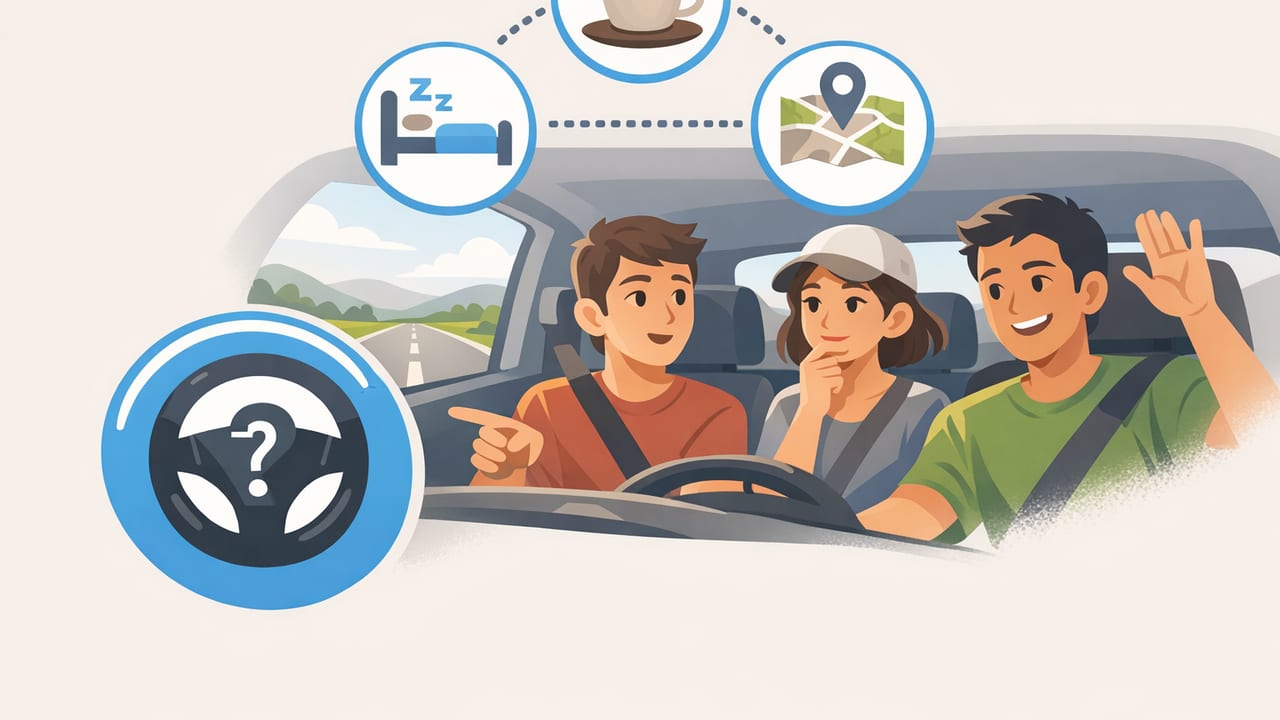
Few things can sour a trip faster than the same question on repeat: “So… who’s driving?” Whether you’re traveling with friends, a partner, or family, using road trip games to choose who drives can turn an awkward negotiation into a light, fair moment that keeps everyone on the same team.
This guide shares practical, low-stress ways to pick a driver (and rotate fairly) without hurting feelings or compromising safety. You’ll find quick games, simple rules, and a ready-to-use fairness checklist—so the only debate left is which snacks to buy.
Before You Play: Driver Choice Should Always Be Safety-First
Games are great for fairness, but they should never override common sense. Agree on a few non-negotiables before you start:
- No one drives if they’re tired, unwell, or distracted.
- No one drives after drinking or using impairing substances.
- The least experienced driver doesn’t “lose” into the hardest conditions (night driving, heavy rain, mountains).
- The car owner can set boundaries (e.g., “Only insured drivers,” “No driving in city centers”).
Fair doesn’t mean identical. Fair means everyone agrees the system is reasonable—and safety comes first.
The Easiest Win: A Simple, Fair Rotation Rule
If your group is debating every switch, the best “game” is a rule you can stick to. Here are three rotation methods that work on most trips:
1) Time Blocks (Best for long highway drives)
Each driver takes a set amount of time (for example, 60–90 minutes). Use rest stops to swap. This feels fair because everyone gives the same time.
2) Distance Blocks (Best when your route is predictable)
Split the route into chunks (for example, 80–120 miles). This is great when you want to plan fuel stops and meals around driver changes.
3) “Hard/Easy” Swap (Best for mixed confidence levels)
Assign tougher segments (city exits, mountain roads, night driving) to confident drivers, and easier highway stretches to others. To keep it fair, balance with a perk system (more on that below).
Road Trip Games to Choose Who Drives: Fast Picks in Under a Minute
Use these when you’re at the driveway, leaving a rest stop, or about to hit a complicated stretch. Each option is quick, clear, and avoids arguments.
Game A: High-Low Guess (No props needed)
- One person thinks of a number from 1–10.
- Everyone guesses at the same time.
- Closest guess drives the first leg (or gets to choose the next driver).
Why it works: Simple, fast, and doesn’t feel like anyone got targeted.
Game B: “Last Photo Taken” Challenge
- Everyone opens their camera roll.
- Compare the timestamp of the most recent photo.
- Most recent photo drives (or, if that feels odd, the oldest recent photo drives—pick one rule and stick to it).
Tip: Set the rule before anyone starts taking new photos.
Game C: License Plate Bingo (First 3 letters)
- Pick a nearby license plate.
- Use the first three letters (or characters) as a prompt.
- First person to say a word for each character wins; winner chooses who drives.
Example: “KQF” → “Kite / Queen / Forest.”
Game D: Rock–Paper–Scissors Tournament (Best for 3–6 people)
Do a quick bracket. Winner picks the driver, but add a fairness guardrail: the winner can’t pick the same person twice in a row.
Game E: Coin Flip With a Twist (Best for two drivers)
Heads: Person A drives first. Tails: Person B drives first. Then switch by time/distance. The “twist” is agreeing upfront on the rotation schedule so the flip only decides the starting point.
Make It Feel Fair: Use a “Driver Perks” Scoreboard
If one person is naturally the best driver (or the only one comfortable in certain conditions), the group can still share the load by assigning perks to whoever drives the tougher leg.
- Snack captain privilege: Driver picks the first snack stop.
- Music veto tokens: Driver gets one “skip anything” token per leg.
- Seat upgrade: Driver gets front passenger seat on the next leg.
- Rest credit: Driver gets a longer break at the next stop.
This keeps everyone invested, even when the driving doesn’t split perfectly evenly.
Road Trip Games That Decide the Driver AND Keep Passengers Busy
Some games work best when passengers play while the car is parked (or before you leave). Others are great at rest stops to decide the next driver.
| Game | Best Time to Play | How It Picks the Driver | Good For |
|---|---|---|---|
| Two Truths and a Lie (Quick Round) | Before departure / rest stop | Last person to guess correctly drives | Friends who like conversation |
| Snack Draft | At the store | Best snack pick (group vote) gets to choose the driver order | Groups who love food stops |
| Map Master | Before leaving | Person who identifies the first 3 towns on the route doesn’t drive first | Trips with planners and navigators |
| Trivia Lightning | Rest stop | Best of 5 questions decides who drives next | Families and mixed-age groups |
Passenger Challenge Add-On: “Co-Driver Points”
To reduce the feeling that driving is the only real “work,” assign points for helpful passenger jobs:
- Navigation and reroutes
- Managing playlists/podcasts
- Ordering ahead for food stops
- Keeping the car tidy
At the next driver decision, the person with the most co-driver points gets to be passenger again, while others rotate into driving. This rewards contribution, not just luck.
A No-Drama Method: The “Three Options” Rule
If your group tends to spiral into debate, use this decision structure:
- List eligible drivers (only those who are rested, willing, and allowed).
- Pick the rotation type (time, distance, or hard/easy).
- Choose one quick decider (coin flip, tournament, random pick).
Then lock it in for at least two legs before changing anything. Constant renegotiation is what creates tension.
How to Handle Common Road-Trip Driver Conflicts (Without Calling It a Fight)
“I always end up driving.”
Switch from “who drives” to “who contributes.” Use co-driver points or perks. If only one person is comfortable driving, acknowledge it and compensate fairly (gas contribution, snack budget, choice of stops).
“I don’t feel safe with X driving.”
Keep it respectful and specific. Focus on conditions: “Let’s have you drive the highway legs, and someone else handles city exits,” or “Let’s swap if anyone feels tired.” Safety is a valid boundary.
“Nobody wants to drive after dark.”
Plan earlier swaps. If night driving is unavoidable, assign the most confident driver for that segment and balance with perks, rest credits, or a shorter next leg.
“We’re all too indecisive.”
That’s exactly when a random method helps—because it removes social pressure. Make sure everyone agrees the randomizer is the final call.
Quick Script: Agree on the Rules in 30 Seconds
Use this as a simple group agreement before you roll out:
- Eligibility: “Only rested, willing drivers.”
- Rotation: “Swap every 75 minutes (or at each fuel stop).”
- Decider: “We’ll do rock–paper–scissors for who starts.”
- Fairness: “Hard legs earn a perk (music veto + snack pick).”
Once it’s stated out loud, the trip runs smoother—because the decision is already made.
When You Want a Truly Neutral Pick
Sometimes even a simple game feels loaded (“You always win rock–paper–scissors,” “That trivia was your topic,” “You picked the number”). In those moments, a neutral random pick can be the cleanest solution—especially if your goal is speed and fairness, not competition.
If you prefer an offline option that combines tools like a wheel spin, coin flip, or random picker in one place, an app like Decision Chooser can help you settle “who drives” quickly and move on with the fun part of the trip.
