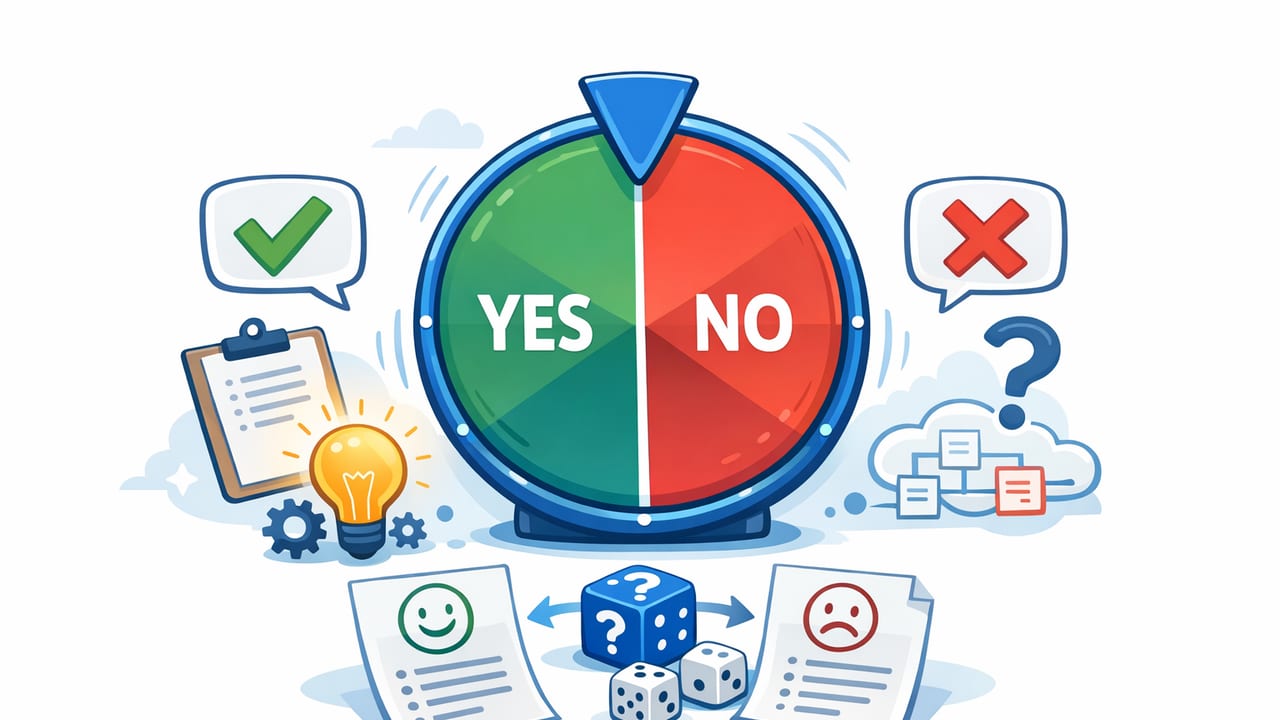
If you’ve ever wished for a random yes or no with reasons, you’re not alone. A simple yes/no decision can feel strangely heavy when you’re tired, overthinking, or stuck between two “fine” options. Randomizing the answer can break the loop—but adding reasons is what makes the decision feel grounded, fair, and easier to commit to.
This guide shows how to use random yes/no decisions responsibly: when it helps, when it doesn’t, and how to attach practical reasons so your choice isn’t just a coin flip—it’s a choice you can stand behind.
Why “random yes or no” works (and why reasons matter)
Random choice is powerful because it removes the mental load of “perfect” decision-making. When the stakes are low-to-medium, randomness can stop analysis paralysis and reduce conflict in groups.
But randomness alone can feel careless. Adding reasons solves three common problems:
- Regret: You’re less likely to second-guess when you can explain the decision logically.
- Fairness: Reasons make it clear the process wasn’t biased or manipulated.
- Follow-through: A reason acts like a mini “plan” (what you’ll do next) instead of an abstract answer.
Randomness is a decision tool. Reasons are what turn it into a decision you can live with.
When to use a random yes or no (and when not to)
Great times to use it
- Low-stakes choices: what to watch, what dessert to get, whether to try a new café.
- Time-boxed decisions: you need an answer in 60 seconds.
- Two acceptable options: either outcome is genuinely fine.
- Group deadlocks: everyone’s preferences are evenly split.
- Breaking procrastination: “Do I start now?” can benefit from a structured yes/no push.
Times to avoid it
- High-risk outcomes: health, legal, safety, major financial commitments.
- Situations needing expertise: decisions that require research or professional advice.
- When ‘no’ has hidden costs: skipping a deadline, ignoring an urgent issue.
A good rule: if you’d feel irresponsible explaining the method to someone you respect, don’t use randomness—use a more deliberate process.
The “Random Yes or No With Reasons” method (5 steps)
Use this quick system whenever you want a fair yes/no result that still feels thoughtful.
-
Write the question in one line.
Example: “Should we order takeout tonight?” (Not: “Should we order takeout tonight even though we probably shouldn’t and we spent money yesterday…”) Keep it clean.
-
Add 2–4 decision constraints.
Constraints are the guardrails that prevent a random answer from pushing you into something dumb. Examples: “Budget under $25,” “Done by 9 PM,” “No long drive,” “Must be vegetarian-friendly.”
-
Create a reasons menu (short, prewritten).
This is the key move. You’re not trying to justify anything after the fact—you’re preparing valid reasons ahead of time. Make two lists:
- YES reasons (e.g., “We’re exhausted,” “It saves time,” “We can choose a healthier option,” “It’s a small reward.”)
- NO reasons (e.g., “We already have food,” “We’re trying to save money,” “Cooking will be faster than delivery,” “We want leftovers for tomorrow.”)
-
Randomize the yes/no.
Pick a method: coin flip, wheel spinner, finger chooser for groups, or a yes/no generator. The method matters less than consistency and transparency.
-
Attach a matching reason (also randomized or chosen).
If the result is YES, pick one item from your YES reasons menu (either randomly or by choosing the one that fits best). If the result is NO, do the same from the NO list. Finish with a next step: “Because reason, we will action.”
Fair ways to generate a random yes/no
Different tools feel fair in different settings. Here’s a comparison to help you choose quickly.
| Tool | Best for | Why it feels fair | Watch-outs |
|---|---|---|---|
| Coin flip | 1:1 decisions | Simple, familiar, fast | Hard to attach reasons unless you prep them |
| Wheel spinner | Groups, fun settings | Visible randomness; customizable | Can be biased if slices aren’t equal |
| Random number (1–2) | Silent or private choices | Neutral, repeatable | Feels abstract without a “story” (reasons help) |
| Finger chooser | Picking who decides | Good for groups; reduces arguments | Not a yes/no directly—more like “who chooses?” |
How to generate “reasons” that don’t feel fake
The biggest mistake with a random yes or no with reasons is inventing reasons after you see the answer. That can feel like rationalization. Instead, build a small reasons library you trust.
Use three types of reasons
- Practical reasons: time, money, distance, schedule.
- Energy reasons: stress level, fatigue, mental bandwidth.
- Values reasons: health, kindness, saving, learning, relationships.
When your reasons include these categories, they’ll feel “real” because they match how people actually decide.
Keep reasons short and action-oriented
- Good: “YES—We need a break. Choose a 30-minute activity and stop.”
- Good: “NO—Budget week. Use what we have and plan a treat on Friday.”
- Less helpful: “YES—Because yes.”
Examples: random yes or no with reasons in real life
Example 1: Should I go to the gym today?
Constraints: 45 minutes max; no intense workout if sleep was under 6 hours.
YES reasons menu: “It will boost mood,” “I’ll sleep better,” “Short session counts.”
NO reasons menu: “Recovery day prevents injury,” “A walk is enough today,” “Sleep comes first.”
Result: YES
Reason chosen: “Short session counts.”
Final decision: YES—because a short session counts, do 10 minutes warm-up + 20 minutes strength + leave.
Example 2: Should we invite more people?
Constraints: space limit; host energy; budget.
YES reasons: “More fun energy,” “They’ll appreciate being included,” “It rounds out the group.”
NO reasons: “Too crowded,” “We want deeper conversations,” “Budget is tight.”
Result: NO
Final decision: NO—because we want deeper conversations, keep it small and plan a bigger hangout next month.
Example 3: Should I buy this item?
Constraints: must be within planned budget; must solve a real problem; no purchase if it’s a stress impulse.
YES reasons: “I’ll use it weekly,” “It replaces something broken,” “It saves time.”
NO reasons: “Wait 48 hours,” “It’s a want, not a need,” “I can borrow/rent.”
Result: NO
Final decision: NO—because waiting 48 hours reduces impulse buys, add it to a list and revisit on Saturday.
How to keep random decisions from becoming avoidance
Random tools are meant to speed up choices, not outsource your life. These simple safeguards keep the method healthy.
- Use a “stakes filter”: If the downside is serious, don’t randomize.
- Limit retries: One roll/flip only. If you re-roll until you like the result, you’re just negotiating with yourself.
- Add a “gut-check” clause: If the random answer triggers immediate dread, pause and ask why. That reaction is useful data.
- Time-box the process: Example: 2 minutes to set constraints and reasons, 10 seconds to randomize, then commit.
Quick templates you can copy
Template A: Instant yes/no with reasons
- Question: Should I ________?
- Constraints: (1) ________ (2) ________
- YES reasons: ________, ________, ________
- NO reasons: ________, ________, ________
- Decision: YES/NO—because ________, I will ________.
Template B: For couples or friends
- Agree first: “We’ll accept the result for tonight.”
- Constraints: budget, distance, time
- Random yes/no: decides “Option A vs Option B” (or “go out vs stay in”)
- Reason: chosen from a shared list to keep it fair
Offline decision-making: why it matters
Some of the most useful decisions happen when you’re offline: on a trip, in a spotty-signal restaurant, during a board game night, or when you’re trying to stay focused and not spiral into browsing. Having offline-friendly decision tools keeps the process quick and consistent—no internet required, no extra friction.
Putting it all together
A random yes or no with reasons is not about removing responsibility—it’s about removing unnecessary delay. When you (1) set constraints, (2) randomize fairly, and (3) attach a prewritten reason with a clear next step, you get the best of both worlds: speed and confidence.
If you prefer keeping multiple decision tools in one place (yes/no style picks, wheels, coin flips, random numbers) with offline use and customization, an all-in-one iOS option like Decision Chooser can make the routine feel effortless—without turning the process into a big production.
