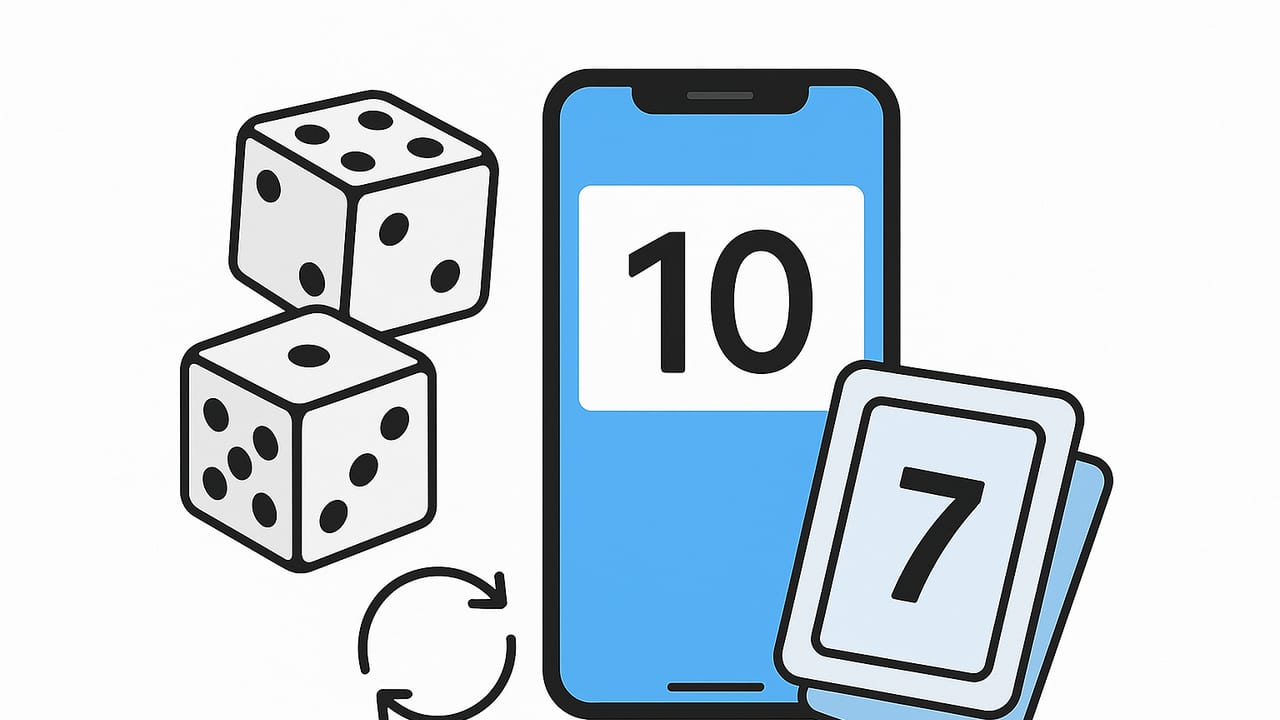
A good randomizer keeps a game moving, prevents arguments, and makes play feel fair. If you have ever paused a session to hunt for a missing die or you needed numbers beyond what your components provide, you know the value of a reliable random number generator for board games. This guide walks through the best options you already own, how to avoid bias, and practical setups for common game nights. Whether you prefer classic dice, cards, or a phone in airplane mode, you will find a method that is fair, fast, and fits your table.
What to look for in a board game randomizer
- Fairness: Results should be uniformly random with no predictable patterns.
- Range flexibility: Support the exact range your game needs, like 1 to 6, 1 to 20, or custom sets such as 2, 4, 6, 8.
- Speed: Minimal setup and instant results keep everyone engaged.
- Consistency: The method should be repeatable and easy to explain.
- Offline reliability: Works without internet so you never stall play.
- Noise level: Quiet enough for late nights and sleeping kids.
- Accessibility: Clear results for all players, including those with low vision or limited dexterity.
- Fun factor: Some randomizers add excitement, anticipation, or ceremony.
Common options and when to use them
Standard dice
Dice are the most familiar random number generator for board games. A six sided die covers many needs, while sets with d4, d8, d10, d12, and d20 expand your range.
- Pros: Fast, tactile, dramatic; no power or internet; easy to understand.
- Cons: Limited to specific ranges; can roll off tables; cheap or worn dice may be unbalanced; noisy on hard surfaces.
- Best for: Most tabletop situations, quick turn order, movement, combat modifiers.
Two dice combinations or special dice
Rolling multiple dice expands possibilities. For example, two ten sided dice can yield 1 to 100, while two six sided dice produce a bell curve from 2 to 12.
- Pros: Flexible ranges; supports distributions other than uniform when desired.
- Cons: Still bound to multiples and mappings; more components to manage.
- Best for: Percent chances, probability curves, upgrading simple games with richer outcomes.
Playing cards
A standard deck offers 52 unique outcomes and easy partitioning into ranges. Shuffle well and map ranks to numbers or colors to categories.
- Pros: Great for no repeats until reshuffle; easy to assign meaning to suits; quiet.
- Cons: Requires shuffling; mapping can confuse newcomers; worn decks clump.
- Best for: Unique draws, player order, event tables, limited resources that should not repeat too soon.
Paper chits or tokens
Write numbers on slips, fold, and draw from a bowl. Replace them after each draw for independent events, or keep them out to avoid repeats.
- Pros: Fully custom ranges; cheap; tactile; silent.
- Cons: Setup time; potential bias if folding or paper thickness differs; needs a container.
- Best for: Custom ranges, classroom sized groups, party prizes, big raffles.
Spinner or wheel
From board game spinners to handheld wheels, a pointer landing on a segment is easy to read and fun to watch.
- Pros: Visual drama; great for kids and party games; segments can be labeled.
- Cons: Bulky; segments must be sized evenly; friction can bias if not centered.
- Best for: Categories, challenges, or any moment where spectacle matters.
Coin flips
Heads or tails is the quickest tie breaker. Stack flips for more outcomes, like two flips for four results.
- Pros: Ubiquitous; instant; decisive.
- Cons: Restricted range unless you stack flips; can roll away.
- Best for: Resolving ties, simple binary choices, initiative in small groups.
Smartphone random number generator apps
Modern phones can generate uniform numbers in any range, spin a wheel, simulate dice, or pick names. Many work fully offline and let you customize lists and weights.
- Pros: Any range you need; quick repeats; quiet; accessible; logs; can replace many tools at once.
- Cons: Needs battery; avoid distractions by turning on focus or airplane mode.
- Best for: Flexible ranges like 1 to 37, replayable setups, travel gaming, classrooms, and parties.
Choosing the best random number generator for board games
Match your tool to the job. If you need simple, tactile, and exciting, roll dice. If you need unique draws without repeats, use cards or chits. If you need flexible ranges and fast setup for many different games, a phone based randomizer is hard to beat. When children are playing, prefer large visuals and quiet results. For late night sessions, minimize clatter and choose soft rolling trays, felt mats, or digital rolls.
How to set ranges and map results without bias
Maintaining fairness means ensuring every allowed outcome has the same chance. Here are reliable mappings:
- Exact match: If you need 1 to 6, roll a six sided die and read it directly. If you need 1 to 12, roll a twelve sided die.
- Two dice for broader ranges: For 1 to 36, roll two six sided dice and read one as tens and one as ones, then add 1; for 1 to 20, use a twenty sided die or two ten sided dice reading as tens and ones.
- Rejection method for odd sizes: If you have a six sided die but need 1 to 5, treat a roll of 6 as a reroll. This keeps each 1 to 5 equally likely.
- Cards for no repeats: To pick players 1 to 8 without repeats, use cards Ace to 8 and deal one to each player for order.
- Wheel segments: Divide the wheel into exactly the number of outcomes you need and keep segment sizes equal. If you must split unevenly, label multiple equal segments with the same result.
For team selection, assign each player a number and use your randomizer to draw numbers without replacement until teams are filled. For event tables where some results should be rarer, roll two dice and use sums that naturally form a curve, such as 2 to 12 with two six sided dice; map less likely sums to powerful events.
Fairness tips to avoid bias and disputes
- Agree up front: State the method, range, and how you handle rerolls before the first draw.
- Roll on a flat, contained surface: Use a tray or box lid to reduce cocked dice and runaway rolls.
- Use clear dice or reliable apps: Heavily worn or novelty dice may be unbalanced; with apps, stick to simple uniform generators.
- Record important results: For tournaments, jot outcomes to avoid memory disputes.
- Handle edge cases consistently: Define what happens with cocked dice, off table rolls, or out of range results.
Quick rule of thumb: if your method would make a statistics teacher frown, add a reroll rule or switch tools.
Fast setups by game type
- Family game night: Use a spinner or a soft rolling tray with large dice to keep noise down. For scoring bonuses between 1 and 10, a phone based generator is quick.
- Party games: A big wheel or name picker keeps energy high. For challenges, prepare a list and have a random picker select items without repeats.
- Strategy euros: When you need precise fairness and quiet, use cards for turn order and a silent phone generator for rare checks.
- Kids and classrooms: Cards and colorful wheels are visual. For fairness, show the choice process openly and avoid tiny text.
- Travel play: Coins and a phone in airplane mode cover almost every need without taking space.
Comparison at a glance
| Method | Fairness potential | Setup speed | Range flexibility | Noise level | Offline | Fun factor |
|---|---|---|---|---|---|---|
| Single die | High with good dice | Instant | Low to medium | Medium to loud | Yes | High |
| Multiple dice | High | Fast | Medium | Medium | Yes | High |
| Playing cards | High with good shuffle | Moderate | Medium to high | Quiet | Yes | Medium |
| Paper chits | High with uniform slips | Slow to set up | Very high | Silent | Yes | Medium |
| Spinner or wheel | Medium if balanced | Fast | Medium | Quiet | Yes | Very high |
| Phone RNG app | High | Instant | Very high | Silent | Yes offline | High |
Frequently asked questions
Are phone based random number generators truly random
They generate uniformly distributed numbers using well tested algorithms that are more than adequate for tabletop play. For game night, this is effectively indistinguishable from physical randomness, and the benefit of exact ranges is significant. If you ever doubt a result, build in a reroll rule or allow a different method by group consensus.
How do we prevent accusations of bias
Agree on a method before the first roll, explain how rerolls work, and keep results visible. Some groups rotate who triggers the randomizer each round. If someone questions a result, pause, restate the rules, and either reroll or switch to a method the whole table trusts.
What is the easiest way to generate a number between 1 and 20 without a twenty sided die
Use two ten sided dice reading one as tens and one as ones, rerolling any 00 or any value above 20. Alternatively, use a card deck by mapping Ace to 1 through 10 as values and drawing twice for tens and ones, again rejecting results above 20.
How can we keep things quiet during late sessions
Roll on felt or in a dice tray, use playing cards or paper chits, or switch to a silent phone generator. Avoid glass tables and switch off animations or haptic clicks if they distract.
What if we need non numeric choices like picking a role or task
Use a wheel labeled with tasks, a list based picker, or cards with roles. For fair distribution over time, remove results after selection and reshuffle or repopulate only when all have been used.
Quick start ideas you can use tonight
- Turn order with cards: Shuffle Ace through however many players you have and deal one each. Highest goes first.
- Custom range on the fly: Write numbers 1 to 12 on slips, mix in a bowl, and draw. Replace after each draw for independent results.
- Silent late night method: Use a phone based generator in airplane mode to produce any range without clatter, holding the screen up for all to see.
- Weighted events: Assign common events to sums in the middle of two six sided dice and rare events to the edges.
Final thought
The best random number generator for board games is the one your table trusts and can use instantly. Keep a couple of reliable options handy, agree on a simple fairness rule, and choose the tool that fits the moment. If you prefer an all in one option that covers dice, wheels, coins, and custom ranges while working offline, an iOS app like Decision Chooser offers flexible randomizers that are easy to show to the whole table.
