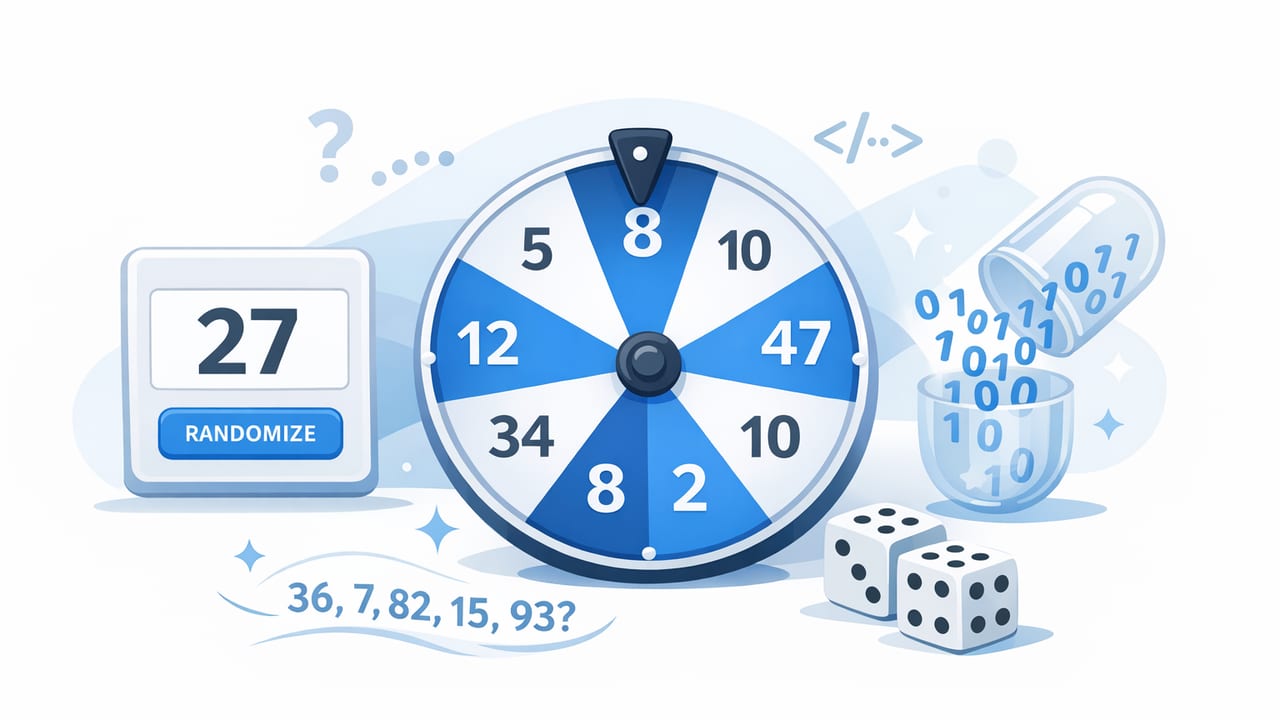
When a decision feels small but sparks big opinions—who goes first, which restaurant to pick, whose turn it is—fairness matters. A random number generator is one of the simplest ways to make quick, unbiased choices without arguing, negotiating, or “accidentally” tilting the outcome.
This guide explains what a random number generator is (in plain language), when it works best, how to set it up for common situations, and how to keep your picks genuinely fair. You’ll also find practical examples you can copy for family life, classrooms, friend groups, and games—plus a quick comparison table of other random methods like dice, cards, and spinners.
What is a random number generator (and why it feels fair)?
A random number generator (often called a “number picker”) is a tool that selects a number unpredictably within a range you choose—like 1–6, 1–10, or 1–100. You assign each person, task, or option a number, then let the generator decide.
People tend to accept the result because:
- It’s transparent: everyone can see the range and the outcome.
- It’s consistent: the same process works for any group size.
- It reduces social pressure: no one has to “be the bad guy.”
- It’s quick: decisions happen in seconds, not minutes.
Fairness isn’t just about the outcome—it’s about trusting the process.
When a random number generator is the best tool
Use a random number generator when your decision:
- Needs to be unbiased (no favorites).
- Has multiple options (more than a simple yes/no).
- Involves turn-taking (games, chores, classroom participation).
- Could cause friction if someone chooses manually.
It’s especially helpful for “low-stakes but high-opinion” choices—exactly the kind that can drain time and energy.
How to use a random number generator in 4 simple steps
- List your options (people, tasks, places, teams, etc.).
- Assign each option a number (1 to N). Keep it visible to everyone.
- Set the generator range (minimum 1, maximum N).
- Generate one number (or multiple numbers if you need a full order).
Tip: If you need a full ranking (like a play order), generate numbers without repeats or remove options after each pick to avoid the same person being chosen twice.
Common everyday scenarios (with ready-to-use number ranges)
1) Who goes first? (games, presentations, errands)
Assign each person a number. Example:
- Alex = 1
- Sam = 2
- Jordan = 3
- Taylor = 4
Set your random number generator to 1–4. One roll decides the first player. For a full order, repeat picks while removing the chosen number each time.
2) Chore assignment without debates
Use numbers for tasks instead of people (or do both). For example, assign chores:
- 1 = Dishes
- 2 = Trash
- 3 = Vacuum
- 4 = Bathroom
- 5 = Laundry
Generate a number for each person. To keep it fair week-to-week, keep a simple rule: no one repeats the same chore twice in a row.
3) Classroom participation that feels equitable
Assign each student a number (or use a seating chart number). Then pick a number when you need:
- A volunteer to read
- A group leader
- A presenter order
Fairness add-on: keep a “picked today” list so students aren’t repeatedly selected in one session.
4) Restaurant choice without the “anything is fine” loop
Make a shortlist first (that’s important). For example, choose 6 acceptable options, assign 1–6, then generate one number. This avoids the most common frustration: “randomly” landing on a place someone didn’t actually want.
5) Raffles, giveaways, or prize draws
If each participant has a ticket number (or entry number), set the range to match the highest ticket number and draw a winner.
Best practice: publicly confirm that every ticket number is included in the range, and decide ahead of time what happens if a number is missing or invalid (e.g., redraw immediately).
How to keep random picks truly fair (avoid hidden bias)
A random number generator is only as fair as the setup. Here are the most common fairness mistakes—and how to fix them.
Mistake 1: Using a range that doesn’t match the options
If you have 7 options but generate 1–10, some numbers won’t map to anything. That can lead to rerolls and confusion. Fix: always match the range to the number of options (1–N).
Mistake 2: Allowing “rerolls” for personal preferences
“Best two out of three” quickly becomes “until I like the result.” Fix: agree on one roll, or a clear rule like: one reroll only if the winner opts out.
Mistake 3: Forgetting to remove winners when choosing multiple results
If you’re assigning multiple prizes or building teams, repeats can happen. Fix: use a method that avoids duplicates, or remove the chosen option after each pick.
Mistake 4: Not defining the rules before generating
Arguments usually happen after the result, not before it. Fix: decide the rules first (range, rerolls, opt-outs, repeats) and then generate.
Random number generator vs other random decision tools
| Tool | Best For | Pros | Watch Outs |
|---|---|---|---|
| Random number generator | Any size group, lists, ranges | Fast, flexible, works for 3+ options | Needs clear mapping (numbers → options) |
| Coin flip | Two choices (A/B) | Simple, familiar, quick | Not useful for more than 2 options |
| Dice | Small ranges (1–6, 1–12) | Fun, tactile, no setup | Limited range; can be lost or unavailable |
| Spinner wheel | Visual group decisions, events | Engaging, easy to see options | Can feel “rigged” if slices aren’t equal |
| Drawing names | One-off selections | Classic, low-tech | Requires prep; can be influenced if not careful |
Smart ways to customize your random number generator workflow
Customization is what turns “random” into “useful.” These approaches keep decisions fast while respecting constraints.
Use a shortlist rule
Before you generate, agree that every option on the list is acceptable. If someone would veto an option, don’t include it. Random selection works best when the list is curated.
Use weighted fairness (without getting complicated)
Sometimes “equal chance” isn’t the goal—balanced over time is. A simple way to weight fairly without advanced math:
- If someone did the task last time, remove them from the next draw.
- If someone hasn’t been chosen lately, temporarily add a “bonus slot” (e.g., give them two numbers instead of one).
This keeps the process simple while smoothing out streaks that feel unfair.
Create repeatable templates
If you often pick from the same set (family chores, game night players, lunch spots), save the list in the same order and reuse it. Consistency reduces setup time and prevents accidental omissions.
Practical examples you can copy today
Example A: Split into two balanced teams
Number players 1–10. Generate a random order (no repeats). Assign:
- Odd positions in the order → Team 1
- Even positions in the order → Team 2
This is fast and avoids the “captains pick friends” problem.
Example B: Choose three winners from a list
If you have entries 1–50:
- Generate a number → Winner 1
- Remove that number
- Generate again → Winner 2
- Remove that number
- Generate again → Winner 3
You’ll avoid duplicates and keep the draw transparent.
Example C: Decide a weekly “mystery activity” fairly
List 8 family-friendly activities (movie night, board game, park, bake something, etc.). Generate 1–8. Add a rule: the same activity can’t win two weeks in a row.
FAQs about using a random number generator
Is a random number generator more fair than a spinner?
Both can be fair. A random number generator is often easier to keep fair because each option maps to one number. Spinners can feel questionable if slices look uneven or the spin feels influenced.
What if the result lands on an option that’s no longer possible?
Decide your rule ahead of time: either remove unavailable options before generating, or allow an immediate redraw only for invalid results.
How do I use it offline?
If you’re traveling, camping, or in a place with poor reception, an offline-capable decision tool matters. Look for a random number generator that works without internet so your process stays consistent anywhere.
A quick checklist for fair, drama-free random picks
- Agree on the options (shortlist first).
- Map options to numbers clearly and visibly.
- Match the range exactly (1–N).
- Set rules before you generate (rerolls, repeats, opt-outs).
- Remove winners when picking multiple results.
- Keep it consistent to build trust over time.
Wrap-up: Small tool, big peace of mind
A random number generator is one of the most flexible decision-making tools you can use: it’s fast enough for everyday life, fair enough for groups, and adaptable to almost any list or scenario. The key isn’t “more randomness”—it’s a clear setup, agreed rules, and a shortlist that everyone can live with.
If you like having multiple quick decision tools in one place (including a random number generator that can work offline), an all-in-one iOS option like Decision Chooser can be a convenient way to keep these moments simple.
