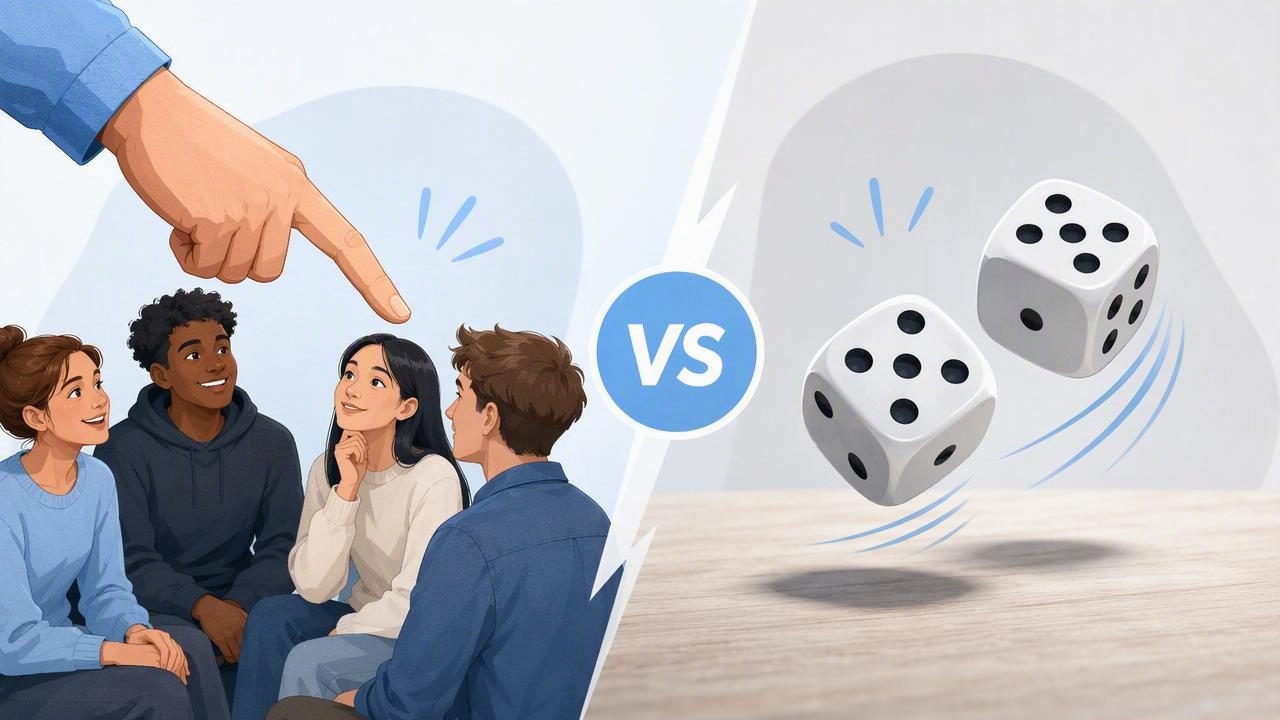
When a group needs to make a quick choice, two classic options often come up: use a random finger picker or roll dice. Both methods can add chance to a decision, reduce debate, and keep a game or activity moving. However, they work best in different situations.
A random finger picker is designed for people who are physically present and ready to participate. Everyone places a finger on one screen, and the picker selects one or more people at random. Rolling dice, on the other hand, works by assigning each possible outcome to a number, color, player, or action.
So, which approach is better? The answer depends on the size of your group, the type of decision you need to make, and whether you want the choice to feel social, simple, or structured. This guide compares a random finger picker vs rolling dice in practical everyday situations.
How a Random Finger Picker Works
A random finger picker lets a small group make a choice together by touching the same device screen. Each person places one finger on the screen, then the tool randomly chooses a participant. Depending on the setup, it may select a single winner or multiple winners.
This method is especially useful when the decision is directly about the people in the room. For example, it can answer questions such as:
- Who goes first in a board game?
- Who chooses the next movie?
- Who gets the last slice of pizza?
- Which two people are on the first team?
- Who has to do a small chore?
The biggest advantage is that there is little preparation. Players do not need to remember assigned numbers or wait for someone to explain what each die result means. Everyone takes part at the same time, which makes the decision feel immediate and visible.
How Rolling Dice Works for Group Decisions
Rolling dice creates a random number. To use dice for a group choice, you need to connect each possible number to an outcome. With two players, this may be as easy as assigning odd numbers to one person and even numbers to the other. With more people, the process can become less direct.
For example, imagine five friends deciding who starts a card game. You could assign each person a number from one to five, roll a six-sided die, and reroll if a six appears. That is a perfectly reasonable method, but it introduces an extra rule: everyone must agree what happens when the unused number is rolled.
Dice are flexible because they can represent many things beyond people. A die can select a challenge, a menu option, a direction, a point value, or a game rule. That makes dice particularly useful when the outcome is a numbered list rather than a person.
Random Finger Picker vs Rolling Dice at a Glance
| Factor | Random Finger Picker | Rolling Dice |
|---|---|---|
| Best for | Choosing among people present | Choosing from numbered outcomes |
| Setup | Participants place fingers on a screen | Assign numbers or outcomes before rolling |
| Group involvement | Everyone participates simultaneously | Usually one person rolls while others watch |
| Useful group size | Small casual groups that fit on one screen | Groups or lists that can be assigned numbers |
| Multiple winners | Can be useful when selecting more than one person | May require repeated rolls and tracking results |
| Physical item needed | A compatible device | At least one die or a digital dice tool |
When a Random Finger Picker Is the Better Choice
A random finger picker is usually the better option when the people participating are also the possible outcomes. It removes the step of assigning everyone a number and makes the selection feel more inclusive.
Example: Choosing Who Goes First
Four friends are sitting down to play a new board game. Instead of discussing who played last time or rolling repeatedly until everyone has a different number, each person places a finger on the screen. The picker chooses one player, and the game begins.
This is a concrete case where a finger-based choice is faster than dice. The group does not need a score sheet, a number assignment, or a reroll rule. The decision is also easy to observe because every player is visibly included in the selection.
A finger picker can also work well when two people need to be chosen. For instance, five classmates may need two volunteers to present first. Rather than roll twice and keep track of who has already been selected, a multi-winner option can identify two participants in one choice.
Simple rule: If the question begins with “Which person?” and the people are standing or sitting together, a random finger picker is often the most natural fit.
When Rolling Dice Is the Better Choice
Dice are often the stronger choice when the possible results are not people touching one device. They are also useful when you want a result from a fixed numbered range.
Consider a family trying to choose a weekend activity from six written ideas:
- Go for a walk
- Visit a museum
- Play mini golf
- Watch a movie
- Make pizza together
- Have a game night
In this situation, a six-sided die is wonderfully direct. Each number matches one activity, so a single roll produces a clear outcome. There is no need for every family member to touch the same screen, and the numbered list makes the result easy to understand.
Dice may also be preferable during tabletop games, where dice are already part of the experience. Rolling can add theme, suspense, and a familiar physical ritual. If a game has rules that refer to die values, using dice keeps everything consistent.
Fairness: What Makes Either Method Feel Fair?
Neither method automatically settles every disagreement. A choice feels fair when the group understands the rules before the result appears and agrees to accept the outcome afterward.
For a random finger picker, fairness starts with participation. Make sure everyone who should be eligible has a chance to place a finger on the screen. If someone joins late, decide before starting whether they are included. If you need one winner, say so clearly; if you need two winners, set that expectation before anyone participates.
For dice, fairness depends on assigning outcomes clearly. If there are five players and one unused number, agree in advance that the unused number means a reroll. Do not change the mapping after the die lands. If there are more outcomes than die faces, consider using multiple dice or narrowing the list first.
It also helps to separate a random choice from an important decision. Chance is excellent for low-stakes questions, such as first turn, dessert selection, or picking a playlist. It is less suitable for decisions involving safety, serious responsibilities, or choices that require discussion and consent.
Common Mistakes to Avoid
- Using a die with too few outcomes: A six-sided die cannot cleanly represent eight people without additional rules.
- Forgetting to explain rerolls: Decide what happens with unused numbers before rolling.
- Trying to fit too many people onto one screen: A finger picker is intended for small casual groups, not a large crowd.
- Changing the rules after the result: If the group keeps rerolling or restarting because they dislike the winner, the process stops feeling fair.
- Using chance for a decision that needs conversation: Random tools can break a tie, but they cannot replace a necessary discussion.
Choosing the Right Tool for Your Situation
Use this quick guide when deciding between a random finger picker and rolling dice:
- Choose a random finger picker when you are selecting one or more people from a small group gathered together.
- Choose rolling dice when you have a clear numbered list of options, especially six or fewer options with one standard die.
- Use either method for low-stakes choices where everyone agrees to the rules before the result.
- Choose a different approach when the group is too large, not all participants are present, or the decision needs thoughtful input rather than chance.
Final Verdict: Finger Picker or Dice?
For selecting people in the moment, a random finger picker is generally quicker and more social. It lets eligible participants take part directly, avoids number assignments, and can make a routine decision feel like a small game. Rolling dice remains a great choice for numbered options, game rules, and situations where a physical roll suits the activity.
For casual decisions involving two to five people on one device, the random finger picker guide from Decision Chooser explains how a finger-based selection can help settle everyday group choices. The key is not choosing the most complicated tool; it is choosing the method that makes the next decision clear, quick, and acceptable to everyone involved.
