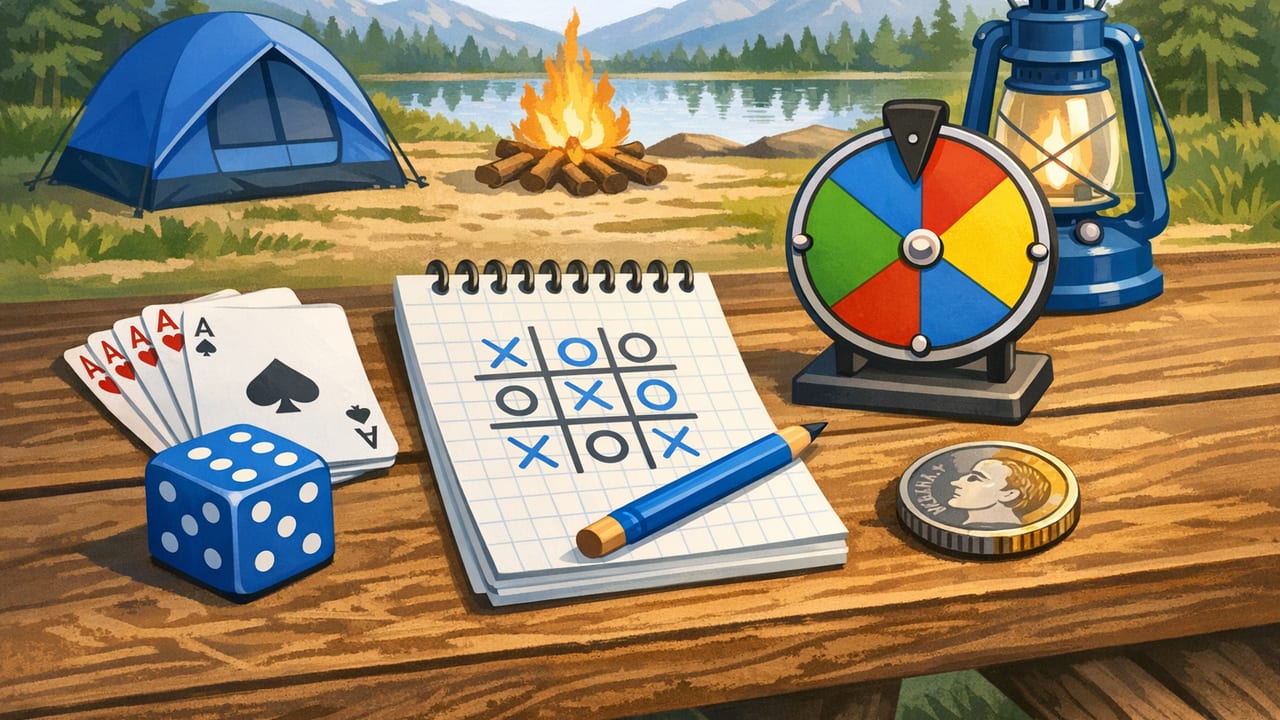
Camping is supposed to simplify life—yet group decisions can get surprisingly complicated once you’re off-grid. Who carries the water? Which trail do you take? Who sleeps in the tent with the “mystery zipper”? When there’s no reception and everyone’s a little hungry, even small choices can turn into long debates.
That’s where an offline tiebreak tool for camping trips earns its keep: a simple, fair way to settle decisions quickly, without relying on the internet (or anyone’s “I swear my idea is best” persuasion skills). This guide walks through practical, offline-friendly tiebreak methods, when to use each one, and how to keep choices fair—so you can get back to the fire, the views, and the fun.
Why “offline” matters on a camping trip
At home, you can default to polls, group chats, or online randomizers. Outdoors, those options may disappear. A good offline tiebreak approach helps when:
- No service (or spotty service) makes online tools unreliable.
- Battery is precious, so you want quick decisions without scrolling or searching.
- Stress is higher (weather, darkness, hungry campers), so arguments can escalate faster.
- Fairness matters (splitting chores, selecting routes, deciding who gets the best sleeping spot).
The best offline tools are fast, easy to explain, and don’t reward whoever argues the loudest.
What makes a tiebreak method “fair”?
Fair doesn’t always mean “random.” It means the group agrees the method is appropriate for the situation. Use these fairness criteria before you pick a tool:
- Transparency: Everyone can see how the result is produced.
- Consent: The group agrees to the rules before the outcome.
- Repeatability: If you do it again, nobody can influence the result.
- Fit for stakes: Higher-stakes decisions may require more discussion than a quick random pick.
Pro tip: Decide your “tiebreak policy” at the start of the trip (or before you leave the trailhead). You’ll avoid debates about how to decide… while trying to decide.
Quick comparison: offline tiebreak options at a glance
| Method | Best for | Pros | Watch-outs |
|---|---|---|---|
| Coin flip | Two options (Trail A vs Trail B) | Fast, familiar, very simple | Only works cleanly for 2 choices |
| Rock–paper–scissors | Two people (who starts, who cooks) | No gear needed, instant | Can feel “skill-based” to some; use best-of-1 or best-of-3 |
| Draw straws (or sticks) | Assigning chores among 3+ people | Offline, physical, memorable | Needs setup; ensure identical-looking straws/sticks |
| Random number (dice or phone offline) | Fair rotation, multiple choices | Scales well; good for schedules | Define mapping (e.g., 1–2 = Alex, 3–4 = Sam…) |
| Spin wheel (paper or offline app) | Games, meal picks, fun decisions | High buy-in; feels playful | Make segments equal; avoid “re-spin until I like it” |
| Finger chooser (point/select) | Choosing a person quickly | Great for “who goes first?” | Agree on the rule (last finger touched, etc.) |
Method 1: The classic coin flip (best for two choices)
If you have exactly two options, a coin flip is hard to beat. It’s quick, easy to verify, and doesn’t require a big explanation.
Camping uses
- Trail split: take the ridge route vs the creek route
- Camp setup: tent spot A vs tent spot B
- Meal choice: tacos vs pasta (when both are equally doable)
Fairness tips
- Assign heads/tails out loud before the flip.
- Flip on a flat surface (or catch and reveal on the back of your hand) so everyone can see the result.
- If the coin gets lost (it happens), use a flat rock with two distinct sides—just agree which side is which first.
Method 2: Rock–paper–scissors (best for two people)
When the decision is really about who does something—rather than which option the group chooses—rock–paper–scissors is a solid, gear-free solution.
Camping uses
- Who starts gathering firewood
- Who takes first dish duty
- Who gets first turn at a camp game
Make it feel fair
- Use best-of-1 for low-stakes tasks, best-of-3 if people care a lot.
- Count down clearly (“1–2–3–shoot”) to prevent timing disputes.
Method 3: Draw straws (or sticks) for chores and rotations
Drawing straws is an old-school group tiebreak that fits camping perfectly. No signal, no batteries, just a physical randomizer everyone understands.
How to do it with what you have
- Collect identical items: straws, toothpicks, or similar-looking sticks.
- Make one item subtly different (shorter/marked) and hide it in your fist with the others.
- Each person draws one. The “special” straw/stick gets the task (or gets first pick, depending on your rules).
Camping uses
- Assigning dishwashing duty
- Deciding who refills water
- Picking who sleeps closest to the tent door
Fairness guardrails
- Use items that look and feel similar to avoid “I could tell by the texture.”
- Rotate responsibilities the next day so one draw doesn’t doom someone for the entire trip.
Method 4: Random numbers (dice or offline phone) for 3+ options
Once you have three or more options—three trails, six snack choices, four people for a task—random numbers are the cleanest way to stay fair.
Option A: Use dice
If someone packed a die (or a small travel game), you can map numbers to people or options.
- Example (4 people): 1–2 = Jordan, 3–4 = Riley, 5 = Casey, 6 = Morgan (then re-roll if needed to balance, or assign 5–6 to Morgan).
- Example (5 dinner ideas): 1–5 = meals, 6 = “group veto / re-roll.”
Option B: Use an offline random number generator
Many phones can generate random numbers without internet if the tool is available offline. This is especially useful for fair rotations (e.g., assigning tasks across multiple days) because you can set a range that matches your group size.
Fairness tip: define the mapping first
Before generating a number, say exactly what each number means. That avoids the classic post-result negotiation: “Wait, can 6 be ‘free pass’?”
Method 5: Spin-the-wheel (paper version or offline tool) for high buy-in
A wheel feels fun—and that matters. If people are tired or indecisive, a playful tiebreaker can reduce tension and increase acceptance of the outcome.
DIY paper wheel (quick campsite version)
- Draw a circle on paper or cardboard (even a notepad page works).
- Divide it into equal slices and write options in each slice.
- Use a pen as the spinner (or flick the wheel and use a fixed pointer).
Great camping uses
- Picking a campfire game
- Choosing tomorrow’s breakfast
- Selecting a “bonus chore” (if you’re gamifying cleanup)
Keep it fair
- Make slices the same size.
- Agree on whether duplicates are allowed (e.g., put “pancakes” twice only if everyone agrees it’s twice as likely).
- Set a “no re-spin” rule unless the result is genuinely impossible (e.g., ingredient missing).
Method 6: A simple vote—then a tiebreak
Random tools are excellent for ties, but not every camping decision should be purely random. If it affects safety, comfort, or energy levels, do a quick vote first.
A practical decision flow
- List options (keep it to 2–5 max).
- Quick pros/cons (30 seconds each, no speeches).
- Vote (show of hands).
- If tied, use your chosen offline tiebreak tool (coin flip, wheel, random number).
This approach balances group input with speed—ideal when everyone has a preference, but you can’t spend all evening debating.
Camping scenarios: which tool to use and why
Scenario A: “Which route do we take?”
Use: vote, then coin flip (2 routes) or random number (3+ routes).
Why: Route choices can affect timing and safety. Let people weigh in first; use randomness only to break a tie.
Scenario B: “Who does dishes tonight?”
Use: draw straws/sticks or random number.
Why: Chores feel fair when assigned by a transparent method. For multi-night trips, rotate so one person isn’t stuck repeatedly.
Scenario C: “What game are we playing by the fire?”
Use: spin-the-wheel.
Why: This is where fun beats formality. A wheel turns indecision into entertainment.
Scenario D: “Who gets the next turn / goes first?”
Use: rock–paper–scissors or finger chooser.
Why: Instant resolution, no setup, minimal drama.
Pack this: a tiny offline tiebreak kit
You don’t need much to be ready. If you like being the person who keeps the trip moving, toss one or two of these in your bag:
- One coin (or a token)
- A small die (d6) or a mini dice set
- A few toothpicks/straws (for drawing)
- A small notepad + pen (for a wheel, lists, mapping numbers)
Optional but helpful: decide a default method for each category (routes, chores, games) before you leave.
Common mistakes that create “unfair” outcomes
- Changing rules after the result: If you allow re-dos, define the only valid reasons in advance (e.g., safety issue, missing gear).
- Too many options: If you put 14 meal ideas on a wheel, people stop caring. Narrow to a shortlist first.
- Hidden weighting: Duplicating an option on a wheel (or giving someone more numbers) is fine only if everyone agrees.
- Using randomness for safety decisions: Don’t coin-flip lightning risk, injury, or navigation uncertainty. Discuss those.
When an offline phone tool makes sense
If you already bring a phone for photos, maps, or emergency use, an offline decision tool can be a convenient backup—especially when you want multiple modes (coin flip, wheel, random number) without packing extra items. The key is making sure it works without internet and is simple enough that everyone trusts the result.
If you’re looking for an all-in-one iOS option that includes multiple offline-friendly decision modes (like a wheel, coin flip, random number generator, and quick “pick a person” tools), you can keep something like Decision Chooser installed before your trip so it’s ready when signal isn’t.
Bottom line
An offline tiebreak tool for camping trips isn’t about avoiding conversation—it’s about preventing small decisions from draining time and energy. Pick a method the group trusts, agree on rules early, and match the tool to the moment. Do that, and you’ll spend less time debating and more time doing what you came for: hiking, eating well, and relaxing outside.
