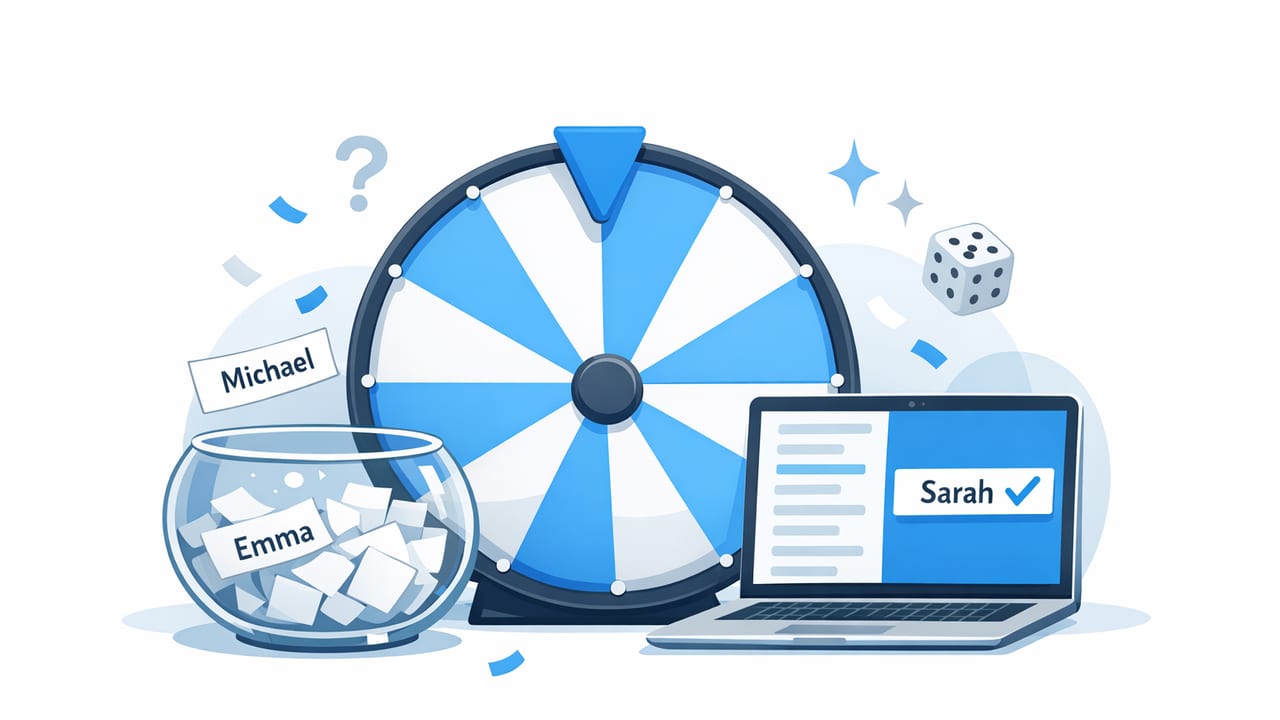
A name picker is one of the simplest decision-making tools: you start with a list of people, then select one at random. That sounds basic, but it solves a surprisingly common problem—how do we choose someone fairly, quickly, and without drama? Whether you’re picking a presenter in a meeting, selecting a team captain, choosing who starts a board game, or deciding whose turn it is to do a task, a good name picker removes bias and keeps things moving.
This guide explains what a name picker is, when to use it (and when not to), and how to set it up so everyone trusts the result. You’ll also learn practical rules that make random selection feel fair—especially in groups where the same people worry about getting picked too often.
What is a name picker (and why people trust it)?
A name picker is any method that randomly selects one name from a set. It can be physical (like drawing paper slips from a jar) or digital (like a wheel spinner or random selector). People tend to trust name pickers because they provide:
- Transparency: everyone sees the list and the selection method.
- Speed: selection happens in seconds.
- Consistency: you can reuse the same rules across situations.
- Reduced social pressure: no one has to “volunteer” or nominate someone.
Random is often kinder than debate. A trusted process can prevent hurt feelings and save time—especially when the choice is low-stakes but emotionally loaded.
Best times to use a name picker
A name picker works best when the decision is shared (everyone is eligible) and the outcome is temporary (turn-taking, short tasks, fun roles). Common examples include:
In classrooms or clubs
- Calling on a student for a quick answer
- Choosing who presents first
- Selecting group leaders or helpers
- Picking a prize winner for participation
At work
- Choosing who starts a round-robin update
- Selecting a facilitator, note-taker, or timekeeper
- Picking who demos first in a team meeting
At home
- Deciding who walks the dog
- Picking whose turn it is to choose a movie
- Assigning small chores fairly
In games and social groups
- Choosing the first player
- Selecting teams or captains
- Picking a judge, storyteller, or “it”
When a name picker is the wrong tool
Random selection isn’t appropriate for everything. Avoid a name picker when:
- Safety or skill matters (e.g., assigning a complex task to someone untrained).
- It could be perceived as punitive (e.g., “randomly” choosing who stays late).
- Eligibility isn’t equal (e.g., some people aren’t available, or the role requires a specific qualification).
In those cases, create an eligibility list first (only qualified/available names), then pick randomly from that smaller set.
Popular name picker methods (and how they compare)
You have several reliable ways to run a name picker. Here’s a quick comparison to help you choose the right approach for your group.
| Method | Best for | Pros | Watch-outs |
|---|---|---|---|
| Paper slips in a jar | Small groups, in-person | Very transparent, no device needed | Time to set up, slips can be lost |
| Wheel spinner | Groups who want a visual | Fun, easy to verify the list | Needs a screen; ensure names are equally weighted |
| Random list picker | Quick “just choose one” moments | Fast and minimal | Less engaging; people may want to see the list clearly |
| Finger chooser (tap-to-pick) | On-the-spot decisions | No typing; great for spontaneous groups | Works best when everyone can touch the screen fairly |
How to set up a fair name picker (rules people accept)
The biggest complaints about name pickers aren’t usually about the randomness—they’re about the rules around the randomness. Use the steps below to make the process feel fair and predictable.
1) Define who is eligible
Before you pick, confirm who’s included. For example:
- Only people present right now
- Only volunteers (opt-in list)
- Only those who haven’t done the role this week
2) Choose your “repeat” policy
Decide what happens after someone is picked:
- Remove after picked: best for turn-taking (everyone gets a chance).
- Allow repeats: best for quick games or low-impact roles.
- Cooldown rule: don’t allow the same person twice in a row, or within the last N picks.
3) Agree on weighting (usually: don’t)
Weighting means giving some names higher odds. Most groups expect equal odds, so only use weighting if everyone understands why (e.g., “new members have higher odds to encourage participation”). If you do weight, explain it upfront.
4) Make the list visible
If possible, show the names before you pick. This prevents “Did you include me?” disputes and builds trust.
5) Lock the pick once it happens
No re-spins because someone groaned. A clean rule is: the first valid result stands. Only redo if there’s an actual error (wrong list, ineligible person included).
Step-by-step: running a name picker in under a minute
- Collect names (say them out loud or write them down).
- Confirm eligibility (present? available? opted in?).
- Pick a method:
- Wheel spinner for visibility and fun
- Random list picker for speed
- Finger chooser for spontaneous groups
- Decide repeat rules (remove after picked vs. allow repeats).
- Run the pick and announce the result.
- Update the list (remove the chosen name if using turn-taking).
Practical scenarios (and the best name picker rule for each)
Scenario A: classroom participation without putting kids on the spot
If the goal is engagement, not embarrassment, consider an opt-in list. Students add their name when they feel ready to answer. Then your name picker chooses from that list. This keeps the benefits of fairness while respecting confidence levels.
Scenario B: assigning rotating responsibilities at home
Use remove after picked and reset weekly. This feels fair because everyone gets a turn before anyone repeats. If someone is unavailable, mark them out for that round rather than re-rolling after the pick.
Scenario C: picking who starts a game (fast and fun)
Allow repeats and keep it simple. A visual spinner adds energy, but a quick random pick is just as fair. The key is speed: get to the game.
Scenario D: choosing a meeting facilitator without resentment
Use a cooldown rule (no one facilitates twice in a row), and keep the eligibility list to people who are comfortable facilitating. This balances fairness with competence.
Common name picker mistakes (and how to avoid them)
- Changing rules midstream: decide repeats/removals before you pick.
- Hidden exclusions: be explicit about who’s in and out.
- Letting complaints trigger re-picks: it undermines trust. Re-pick only for factual errors.
- Overcomplicating: for low-stakes choices, simple random is usually best.
Offline name picker: why it matters more than you think
Not every decision happens with perfect connectivity. Sleepovers, camps, road trips, basements, gyms, and classrooms with spotty Wi‑Fi all benefit from tools that work offline. Even when you do have service, offline-ready options can be faster and more reliable because you’re not waiting on a webpage to load.
If you often rely on a name picker in the same places (classroom, home, weekly game night), it’s worth choosing a method that doesn’t depend on an internet connection.
Customization tips that make a name picker feel “made for your group”
Customization isn’t just cosmetic—it can improve clarity and fairness.
- Use nicknames people recognize instantly (avoid confusion).
- Create preset lists (e.g., “Family chores,” “Book club,” “Team A”).
- Add role-based entries when relevant (e.g., “Guest,” “New member”).
- Set a consistent reset point (daily, weekly, per session) for turn-taking lists.
FAQ: quick answers about name pickers
Is a name picker really random?
A well-designed name picker aims for unbiased selection among eligible names. For group trust, the bigger factor is usually process transparency—show the list, set rules first, and don’t redo picks casually.
What’s the fairest approach for turn-taking?
Remove after picked until everyone has been selected, then reset. This prevents repeats and feels fair over time.
What if someone isn’t present or can’t do the role?
Mark them ineligible before you pick. If you forgot and they’re picked, treat it as an eligibility error: fix the list and pick again once.
Wrapping up: the simplest way to reduce everyday friction
A name picker is a small tool with a big payoff: it replaces awkward negotiations with a quick, fair result. If you set clear eligibility rules, decide your repeat policy in advance, and keep the list visible, most groups will accept the outcome—even when it’s not what they hoped for.
If you prefer keeping a few decision-making tools in one place (like a wheel spinner, finger chooser, coin flip, and random number option) and want them available offline, an all-in-one iOS app such as Decision Chooser can be a convenient way to run a name picker wherever you are.
