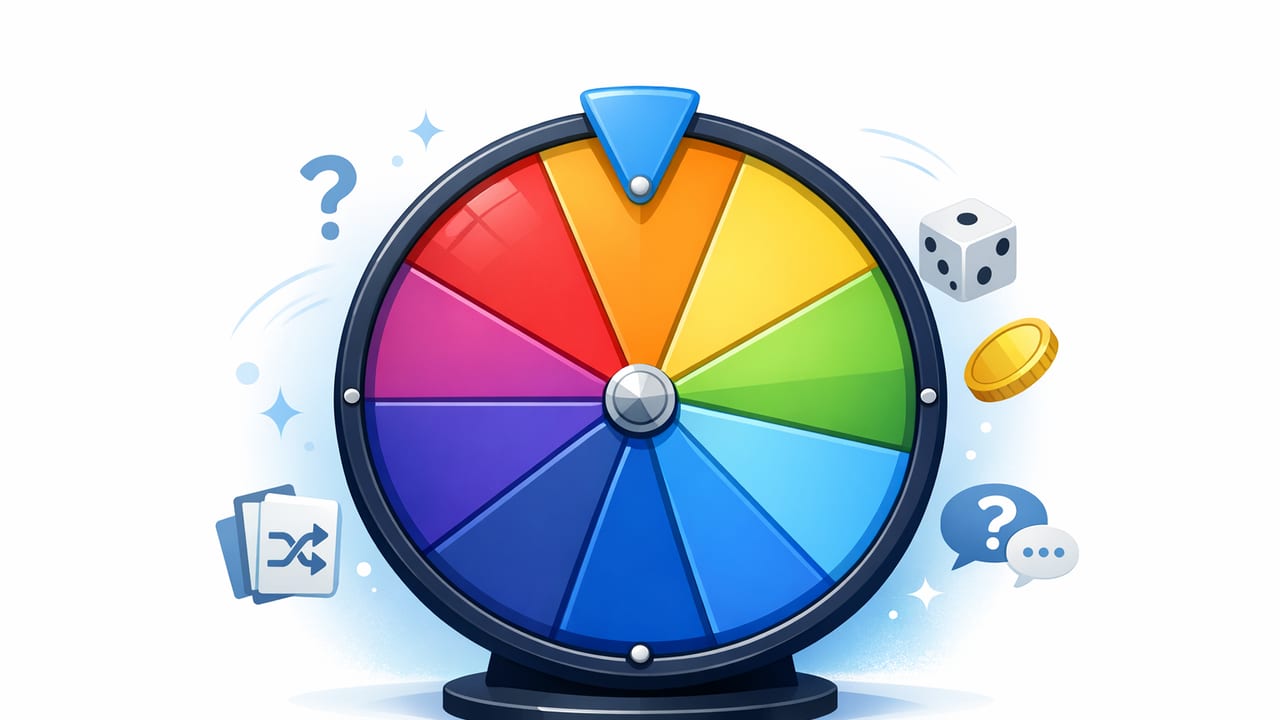
A random choice spinner is one of the simplest ways to settle everyday decisions without debates, bargaining, or “fine, whatever you want.” Whether you’re choosing dinner, assigning chores, picking a game, or breaking a tie, a spinner turns a messy conversation into a quick, transparent outcome: spin, watch, accept.
This guide explains how a random choice spinner works, when it’s the best tool, how to set it up for fairness, and how to avoid common pitfalls that make “random” feel suspicious. You’ll also get ready-to-use lists and practical examples you can copy into your own spinner.
What a Random Choice Spinner Is (and Why It Works)
A random choice spinner is a digital (or physical) wheel divided into labeled sections—each section is an option. You spin the wheel, and the final pointer position determines the choice. The value isn’t just randomness; it’s the combination of:
- Speed: it ends decision loops quickly.
- Visibility: everyone sees the same spin and result.
- Perceived fairness: the process feels impartial, especially in groups.
- Reduced social pressure: no one has to “be the bad guy.”
When people agree on the process, they accept the outcome more easily—even if it’s not their favorite option.
When to Use a Spinner vs Other Randomizers
A spinner is ideal when you have multiple options and want a decision that feels fun and public. Other randomizers can be better in specific situations. Here’s a quick comparison:
| Method | Best for | Pros | Watch-outs |
|---|---|---|---|
| Random choice spinner | 3+ options, groups, game nights | Visual, engaging, easy to accept | Must set equal slices (or disclose weights) |
| Coin flip | Two choices, quick tiebreaks | Fastest, universally understood | Not helpful with many options |
| Random number generator | Numbered lists, seating, raffle entries | Very scalable | Less “fun,” requires mapping numbers to items |
| Drawing straws | In-person, no phone available | Simple physical method | Easy to mess up, less transparent |
How to Set Up a Fair Random Choice Spinner
Fairness is mostly about clarity. People get upset not because randomness is “wrong,” but because they suspect the setup was biased. Use these steps to keep things clean:
1) Define the decision in one sentence
Be specific. “What should we eat?” is vague. “Where should we order dinner from tonight?” is better.
2) Agree on the option list before spinning
Write down all options first, then lock them in. If someone adds a new option after the first spin, it can feel like moving the goalposts.
3) Keep slice sizes equal (unless you openly choose weights)
If every option is equally acceptable, use equal slices. If you intentionally want weighting (for example, “cook at home” should be more likely than “sit-down restaurant”), say so before you spin.
4) Remove duplicates unless they’re intentional
Repeating an option effectively increases its odds. That can be a feature, but it must be explicit: “We’re adding ‘tacos’ twice because everyone wants it.”
5) Decide what happens after the spin
Agree on a simple rule:
- One-and-done: the result stands.
- Best-of-three: useful if you want extra “random confidence.”
- Veto tokens: each person gets one veto per week (great for food choices).
Practical Spinner Templates (Copy These Lists)
Below are ready-to-use sets you can paste into a random choice spinner. Edit based on your group’s budget, dietary needs, or time.
Dinner picker (balanced and realistic)
- Tacos
- Pizza
- Sushi
- Burgers
- Thai
- Salad bowls
- Ramen
- Cook at home (simple)
Family chores (quick rotation)
- Dishes
- Trash & recycling
- Sweep/vacuum
- Wipe counters
- Bathroom quick clean
- Fold laundry
- Feed pets
- Yard/plant check
Game night chooser (mix of vibes)
- Party card game
- Co-op board game
- Trivia
- Charades
- Word game
- Classic (chess/checkers)
- Video game (short rounds)
- Mini-tournament (winner stays)
How to Handle “But That’s Not Fair!” Moments
Even with a fair setup, emotions happen. Here are fixes that preserve trust while keeping decisions fast.
Use a “shortlist then spin” method
When the option list is huge, people can feel like the spinner picked something random and irrelevant. Instead:
- Each person nominates 1–2 options.
- Combine nominations into a shortlist.
- Spin from that shortlist.
Add a “no repeats” rule
For weekly routines (like dinners or chores), prevent the same result from appearing twice in a row. If it lands on last time’s choice, spin again. This doesn’t make it mathematically pure, but it often feels more fair in real life.
Separate “random” from “acceptable”
Randomness doesn’t solve a bad option list. If someone truly can’t do an option (allergy, budget, time constraints), remove it before spinning. A fair process still needs a sensible menu of choices.
Weighted Spinners: When “Equal Odds” Isn’t the Goal
Sometimes the fairest outcome is not equal probability—it’s proportional probability. A weighted random choice spinner can help you balance competing priorities without endless negotiation.
Examples of good weighting:
- Budget control: make “cook at home” more likely than “delivery.”
- Training plans: spin workouts where recovery days appear more often.
- House rules: “pick a movie” appears less often than “pick a short episode.”
Best practice: announce the weights out loud before you spin. Transparency matters more than the exact percentages.
Common Mistakes That Make a Spinner Feel Rigged
- Changing the list mid-argument: decide the list first, then spin.
- Too many joke options: keep humor, but don’t overload it.
- Duplicate entries without saying so: duplicates are weighting—be explicit.
- Letting one person build the list alone: group buy-in increases acceptance.
- Using the spinner for high-stakes decisions: it’s great for everyday choices, not life-altering commitments.
Real-Life Scenarios: Simple Rules That Keep Everyone Happy
Scenario 1: “Where should we eat?” with picky friends
Rule: Everyone removes one option they truly won’t do; then spin.
This avoids the classic problem where the spinner lands on something one person never intended to accept.
Scenario 2: Siblings arguing over who goes first
Rule: Create a wheel with names; winner goes first, then remove that name for the next round.
This keeps the selection fair across repeated turns.
Scenario 3: Office “volunteer” tasks
Rule: Make the spinner public and rotate the eligible list each week.
Fairness improves when the process is consistent and visible to everyone.
FAQ: Random Choice Spinner Questions People Actually Ask
Is a spinner truly random?
In practice, it’s random enough for everyday decisions—especially when the setup is transparent and slice sizes match your intended odds. The bigger issue is usually perceived fairness, not perfect randomness.
How many options should a wheel have?
For quick decisions, 6–12 options is a sweet spot. Fewer can feel repetitive; more can feel chaotic and make the result seem arbitrary.
What if the group rejects the result?
That’s a sign the option list wasn’t truly acceptable. Use a veto rule, rebuild the shortlist, or set constraints (budget/time/diet) and spin again.
Can I use a random choice spinner for giveaways?
Yes—if your entries are clean (no duplicates unless allowed) and you’re transparent about the rules. For large lists, a random number approach mapped to entries can be easier, but a spinner is more engaging for small-to-medium pools.
A Simple “Fairness Checklist” Before You Spin
- We agree on the question we’re answering.
- We agree the option list is complete.
- Everyone finds every option acceptable (or veto rules exist).
- Slice sizes match our intended odds (equal or weighted).
- We agree on what happens after it lands.
If you can say “yes” to these, your random choice spinner will feel fair, fast, and surprisingly calming—even in groups that usually argue.
Gentle tip: if you like having multiple decision tools (spinner, coin flip, quick random picks) available offline in one place, an all-in-one iOS app like Decision Chooser can be a handy option.
