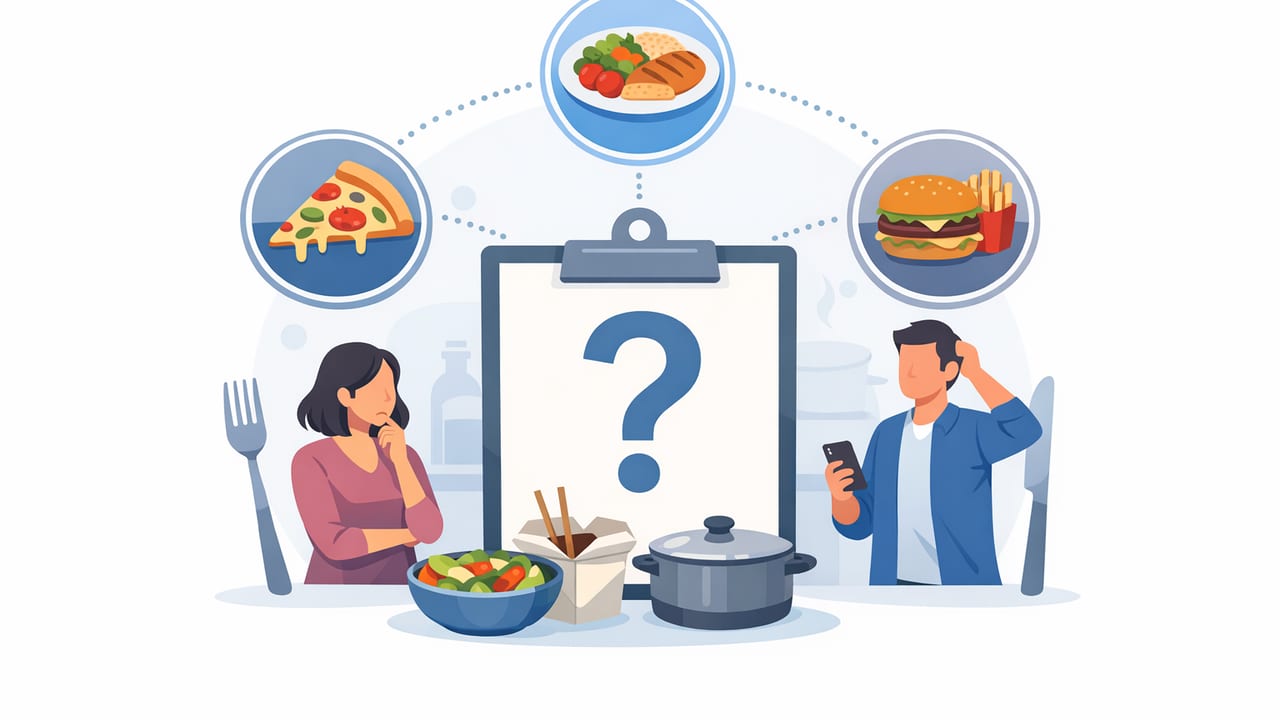
Needing dinner decision help is incredibly common—even for people who love food. The problem usually isn’t a lack of options; it’s too many options, mixed preferences, and a tired brain at the end of the day. When you’re hungry, every choice feels bigger than it is, and small decisions can turn into a debate, a scroll-fest, or a last-minute snack situation.
This guide gives you practical, repeatable ways to decide what’s for dinner—whether you’re choosing alone, with a partner, or with a group. The goal isn’t a “perfect” meal; it’s a good-enough decision made quickly, with less stress and fewer arguments.
Why deciding dinner feels so hard (and why it’s normal)
Dinner decisions hit at the worst time: you’re tired, maybe hungry, and you’re trying to balance health, budget, time, and taste. Psychologists often describe this as decision fatigue—the more choices you make in a day, the harder each new one feels.
“When your energy is low, the easiest decision is no decision—until hunger forces one.”
The fix isn’t superhuman willpower. It’s using simple structures that reduce the number of choices you have to consider.
Step 1: Shrink the decision in 60 seconds
Before you pick a meal, narrow the playing field. Use this quick filter:
- Time: How long do you realistically have—10, 20, 40 minutes?
- Effort: Are you cooking, assembling, reheating, or ordering?
- Budget: Is this a “use what we have” night or a “treat” night?
- Constraints: Any allergies, dietary goals, leftovers to use, or picky eaters?
Once you answer those four, you’ve already eliminated most options—and the final decision becomes lighter.
Step 2: Use one of these proven decision methods
Different nights need different tools. Here are practical methods that work in real life.
Method A: The “Top 3” shortlist
Write (or say) three dinner options that fit your time and budget. Not ten. Three. Then pick one.
- If you’re alone: choose your favorite of the three.
- If you’re with someone: each person suggests one, and the third is a shared fallback (like leftovers).
Why it works: it reduces overwhelm while still giving you choice.
Method B: “Yes/No” elimination (fastest for tired nights)
Instead of asking “What do we want?”, ask “Do we want this?” Start with one concrete option and move quickly:
- Pick one idea (e.g., tacos).
- If it’s a no, immediately propose the next (e.g., stir-fry).
- Stop at the first “yes.”
Tip: Set a timer for 2 minutes. If there’s no yes by then, use a fallback (see below).
Method C: Theme nights (decide once, benefit all month)
Theme nights remove the question “what kind of food?” so you only decide the specific dish. Examples:
- Monday: pasta
- Tuesday: tacos or wraps
- Wednesday: sheet-pan dinner
- Thursday: soup/salad/sandwich
- Friday: takeout or freezer meal
Why it works: fewer categories to debate, less planning from scratch.
Method D: The fair random pick (best for groups)
If you’re stuck in a loop (“I don’t care—what do you want?”), randomness can be the cleanest solution—especially when everyone is basically fine with multiple options.
How to do it well:
- Agree on a shortlist (5–8 options max).
- Remove anything someone truly dislikes (no “suffering votes”).
- Randomly select one option from the list.
Key rule: Random works best when the options are all acceptable. If one choice would cause frustration, don’t include it.
Quick comparison: which method should you use tonight?
| Situation | Best method | Why it helps |
|---|---|---|
| You’re exhausted and hungry | Yes/No elimination | Minimal thinking, quick momentum |
| You want variety without planning | Theme nights | Fewer categories, less debate |
| You and a partner keep deferring | Top 3 shortlist | Small set of realistic choices |
| Group can’t agree | Fair random pick | Neutral, reduces arguing |
| You have ingredients to use up | Constraint-first filter | Narrows options based on reality |
Build your “default dinners” list (your personal safety net)
The fastest dinner decision help often comes from having a short list of meals you can make (or buy) without much thought. Create a list of 10 default dinners—then rotate them when you’re tired.
Include a mix of:
- 5 quick cook meals (20 minutes or less)
- 3 pantry/freezer meals (always available)
- 2 “no-cook” meals (assembly only)
Examples of default dinners
- Eggs + toast + salad
- Stir-fry with frozen veg + rice
- Sheet-pan chicken (or tofu) + veggies
- Pasta + jar sauce + spinach
- Tacos/wraps with whatever protein you have
- Soup + grilled cheese
- Frozen dumplings + steamed greens
- Greek-style bowl: cucumber, tomato, chickpeas, feta, pita
- “Snack plate” dinner: hummus, veggies, crackers, fruit, nuts
- Leftover remix: fried rice, quesadillas, or salad topper
Once you have this list, you can decide dinner by choosing a number from 1–10 (or randomly selecting one) instead of reinventing the wheel.
Stop the “I don’t care” loop in couples and families
“I don’t care” usually means “I don’t want the responsibility of making the wrong pick” or “I’m too tired to think.” Here are a few scripts and rules that keep it kind and efficient:
Use “two options and a question”
Instead of open-ended asking, offer two realistic options:
- “Do you want pasta or tacos?”
- “Are you in the mood for something warm or something fresh?”
Try “veto power” instead of “full control”
One person chooses; the other gets one veto. If they veto, they must immediately suggest an alternative. This prevents endless rejection without effort.
Rotate responsibility
Simple schedule:
- Person A decides Mon/Wed
- Person B decides Tue/Thu
- Fri is leftovers/takeout
Less negotiation, fewer repeated debates.
When ordering in: decide faster without scrolling forever
Ordering can be harder than cooking because there are infinite menus. Reduce it with constraints:
- Pick a cuisine first (Italian, Thai, burgers, etc.).
- Set a price cap (“Under $15 per person”).
- Use the “same-order rule”: choose 1–2 reliable dishes you like and only change if you truly want to.
If multiple people are ordering, use a shortlist and then a fair random pick. It’s surprisingly effective at ending the scroll spiral.
A simple fallback plan for nights when nothing sounds good
Sometimes the real problem isn’t choosing—it’s low appetite, stress, or being over-tired. Have a fallback meal that’s nourishing and nearly automatic.
Good fallback ideas:
- Breakfast-for-dinner (eggs, oatmeal, yogurt bowls)
- Freezer staple (dumplings, veggie burger, frozen soup)
- Pantry bowl (rice + beans/chickpeas + sauce + greens)
- Simple comfort combo (tomato soup + toast)
Make it a rule: If no decision is made by a set time (for example, 6:30), you automatically choose the fallback. This removes pressure and keeps everyone fed.
Mini checklist: dinner decision help in under 3 minutes
- Pick your time limit: 10 / 20 / 40 minutes.
- Choose the format: cook / assemble / order / leftovers.
- Make a shortlist of 3–5 options.
- Eliminate any hard no’s.
- Select: choose your favorite, or use a fair random pick.
- Commit for tonight. You can pick differently tomorrow.
Make it easier next week (without meal-prepping your whole life)
You don’t need an intense system to reduce dinner stress. Two small habits create big relief:
- Keep a running “wins” list: when a dinner works, add it to your default dinners.
- Do a 5-minute weekly reset: pick 2–3 dinners you’ll repeat, then keep the rest flexible.
The goal is not rigid planning—it’s removing the nightly pressure to invent something from scratch.
Final thought
Most nights, the best dinner decision is the one you can make quickly and feel okay about. Use a shortlist, a theme, or a fair random pick—and give yourself permission to keep it simple. If you prefer making those quick, fair picks on your phone (even offline), an all-in-one option like Decision Chooser can help you choose from a custom dinner list in seconds.
